
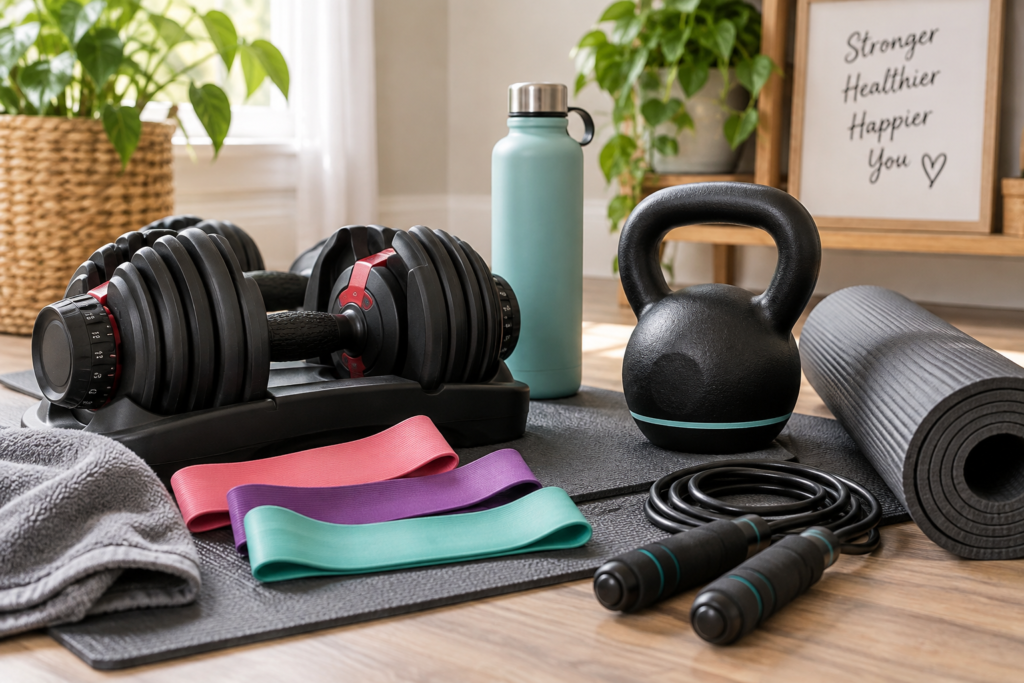
A home gym doesn’t have to mean turning an entire room into a fitness studio. A few well-chosen home gym gadgets can help you move more consistently, whether you’re easing back into exercise, building strength, or simply looking for a practical way to stay active on a busy day.
The best setup is usually the one that fits your space, budget, routine, and comfort level. Start small if that feels right. One useful piece of equipment can be enough to make your next workout feel more doable.
Affiliate note: This article may contain affiliate links.
🔥 Top Picks
- Best Overall: Adjustable Dumbbells
- Best Budget: Resistance Loop Bands
1. Adjustable Dumbbells
Adjustable dumbbells are one of the most useful additions to a home gym because they support many kinds of workouts without requiring a shelf full of separate weights. Depending on the set you choose, you can change the resistance as your strength grows or use different weights for different exercises.
They work well for familiar strength moves like squats, lunges, rows, presses, deadlifts, and biceps curls. They can also be helpful if more than one person in your household wants to use the same equipment but needs a different resistance level. For beginners, lighter settings make it easier to learn movement patterns slowly. For experienced exercisers, heavier settings can add a challenge to a short workout.
The main considerations are storage and ease of adjustment. Some sets take up more room than others, and it helps to choose a safe, clear spot where you can store them between workouts.
Why it stands out: Adjustable dumbbells give you flexible strength-training options while taking up less space than a full set of individual weights.
2. Resistance Loop Bands
Resistance loop bands are simple, affordable home gym tools that can be surprisingly versatile. These small circular bands are often placed around the thighs, ankles, or calves to add resistance to lower-body exercises, but they can also support warm-ups, mobility work, and gentle strength routines.
They’re especially helpful if you’re new to exercise or returning after time away, since they offer a lower-impact way to work your muscles without lifting heavy equipment. Try them with glute bridges, side steps, squats, or leg lifts. A set with several resistance levels gives you room to begin gently and progress over time.
Because they’re compact, loop bands are easy to keep in a drawer, basket, or travel bag. They also work well in small apartments, shared spaces, or homes where workout gear needs to disappear when the day is done.
Why it stands out: Resistance loop bands make it easy to add a gentle, adjustable challenge to your workout without taking over your home.
3. A Supportive Exercise Mat
An exercise mat may not feel as exciting as a new set of weights, but it can make home workouts more comfortable and inviting. A supportive mat creates a designated place for stretching, bodyweight workouts, yoga, Pilates, mobility work, or floor exercises like planks and glute bridges.
If you exercise on hard flooring, a mat can provide cushioning for your knees, back, hands, and elbows. It can also help define your workout space, even if that space is only a small corner of the living room. Rolling it out can become a helpful cue that it’s time to move, stretch, or take a few minutes for yourself.
Look for a mat that suits the type of movement you enjoy. A thicker option may feel better for floor work, while a firmer mat can provide steadier footing for balance exercises.
Why it stands out: A good exercise mat makes many forms of movement more comfortable, accessible, and convenient at home.
4. Kettlebell
A kettlebell is a compact piece of equipment that can bring variety to strength and conditioning workouts. Its handle lets you hold it differently from a traditional dumbbell, making it useful for carries, squats, deadlifts, presses, and controlled swinging movements.
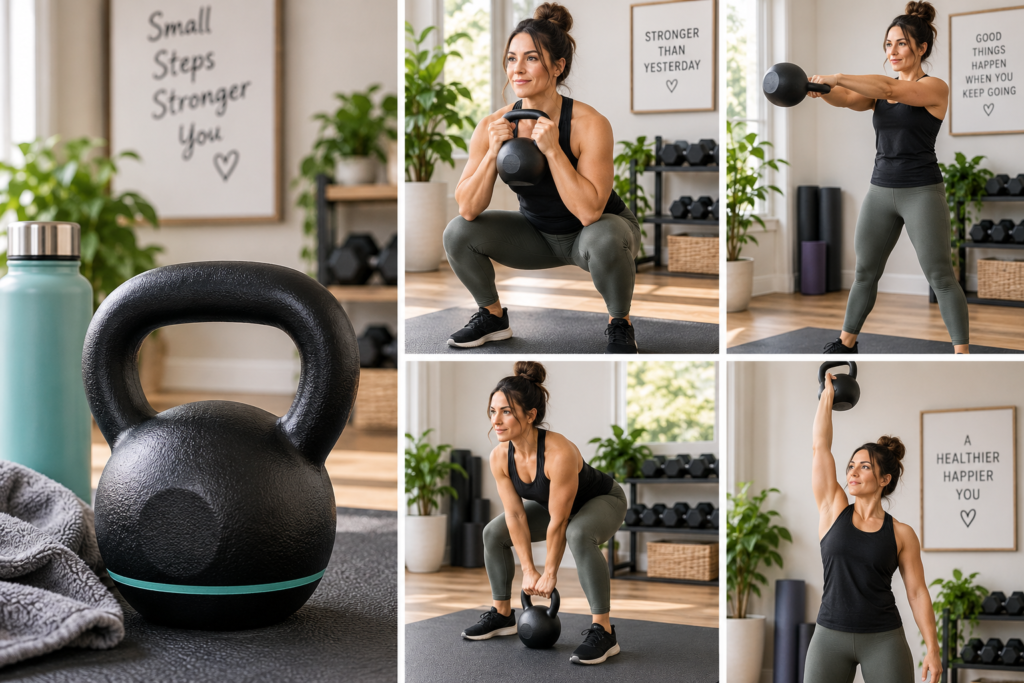
For many people, a single kettlebell is enough to create a straightforward full-body routine. You might use it for a few slow strength exercises one day and a more active circuit another day. It’s a good option if you prefer equipment that feels simple and doesn’t need much setup.
That said, kettlebell movements require attention to form, especially when you’re learning exercises that involve swinging or lifting from the floor. There’s no need to rush into advanced moves. Beginning with basic holds, squats, and deadlifts can help you become comfortable with the weight and the movements.
Why it stands out: One kettlebell can support a wide range of full-body strength exercises while taking up very little space.
5. Jump Rope
A jump rope is a classic fitness tool for good reason: It’s portable, straightforward, and easy to pull out when you want a quick burst of movement. You can use it for a short warm-up, an interval workout, or a few minutes of cardio between strength exercises.
If traditional jumping feels uncomfortable or intimidating, you can still use a rope more gently. Try stepping over it one foot at a time, practicing the arm motion without jumping, or doing short intervals with plenty of rest. There’s no rule saying a jump-rope workout has to be fast or intense to count.
Before bringing one home, consider your ceiling height, flooring, and available space. A clear area matters, especially if you live with others, have low ceilings, or need to avoid noisy workouts. Outdoor use may be a better fit for some households.
Why it stands out: A jump rope offers an easy way to add cardio to your routine without investing in large equipment.
6. Foam Roller
A foam roller isn’t a replacement for rest, medical care, or listening to your body, but it can be a useful recovery tool. Many people use one for gentle self-massage around areas that feel tight after sitting, walking, strength training, or everyday activity.
You can use it before a workout as part of your warm-up or afterward for a few quiet minutes of slower movement. Common areas include the upper back, calves, glutes, and thighs, though comfort varies from person to person. You don’t need to push through discomfort. A lighter touch and slow, controlled movement are often plenty.
Foam rollers come in different textures and firmness levels. If you’re sensitive to pressure or brand new to using one, a smooth, less intense option may feel more approachable than a deeply textured roller.
Why it stands out: A foam roller supports a more well-rounded home fitness routine by making room for both recovery and exercise.
7. Doorway Suspension Trainer
A doorway suspension trainer uses straps and handles attached to a secure anchor point, allowing you to use your body weight for strength exercises. You can use it for rows, supported squats, chest presses, lunges, planks, and other movements, adjusting the difficulty by changing your body angle.
This can be a helpful option if you want more variety than bodyweight exercises alone provide but don’t have room for a large machine. It also offers balance support, which may make some lower-body exercises feel more manageable. Moving your feet closer to or farther from the anchor changes the challenge without requiring you to swap equipment.
Safety deserves extra attention here. Always follow the product’s instructions, check that the door and anchor point are suitable, and make sure the surrounding area is clear before you begin. If a doorway setup doesn’t work in your home, resistance bands may offer a simpler alternative.
Why it stands out: A suspension trainer gives you adjustable bodyweight strength training without requiring much floor space.
8. Stability Ball
A stability ball can add balance work and variety to your home workouts. It’s often used for core exercises, gentle stretching, wall-supported squats, modified push-ups, and seated movement. You may also enjoy using one for light mobility exercises during long days at a desk.
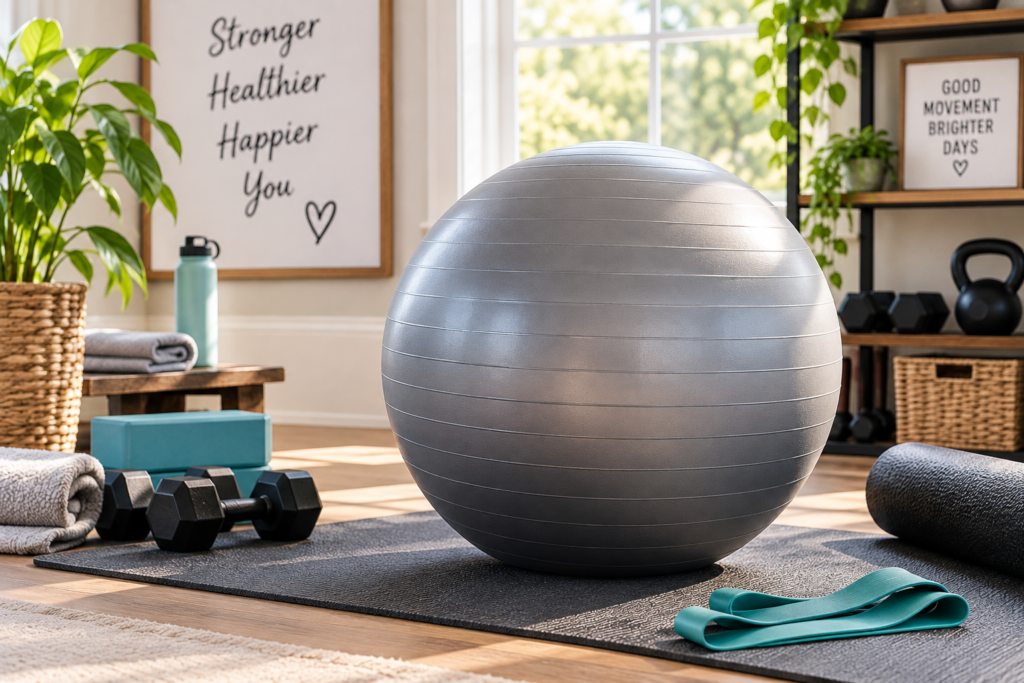
Because the ball shifts beneath you, even simple exercises can require more attention and control. That can be useful, but it also means it’s wise to start slowly. Choose movements that feel stable, and keep the ball away from stairs, sharp objects, and slippery floors. A clear area gives you more room to move safely.
Storage is the biggest drawback for many homes. Unlike bands or a jump rope, a stability ball takes up visible space when inflated. Still, if you have room for it and enjoy low-impact core or balance work, it can be a worthwhile addition.
Why it stands out: A stability ball brings balance, core engagement, and gentle movement options to your home gym routine.
9. Walking Pad
A walking pad can be a practical choice if your goal is simply to walk more often without depending on the weather, daylight, or a trip to the gym. It may fit naturally into a routine of listening to a podcast, catching up on a favorite show, or taking a short walk between tasks at home.
Walking can be an approachable way to begin moving regularly, especially if high-impact workouts don’t appeal to you. A walking pad supports short sessions throughout the day rather than requiring one long, formal workout. Even a brief walk can provide a welcome change of pace after hours of sitting.
Before purchasing, think about how much room you have, where you’ll store the equipment, whether your flooring needs protection, how much noise it may make, and any household safety concerns. If a walking pad feels like too much equipment right now, walking outdoors or following low-impact indoor movement videos can still be a meaningful start.
Why it stands out: A walking pad makes it easier to build simple, consistent walking into everyday life at home.
10. Smart Fitness Tracker
A smart fitness tracker can be useful if you enjoy having a gentle reminder of your movement habits. Depending on the device and its features, it may help you track workouts, daily activity, timers, or personal goals. Seeing your routine in one place can make it easier to notice patterns and celebrate consistency.
The most helpful approach is to treat the tracker as a source of information, not a scorecard. A low-activity day does not mean you’ve failed, and a device cannot fully account for rest, caregiving, illness, stress, or everything else real life holds. It should support your well-being, not make you feel like your own wrist is watching you.
If tracking numbers makes exercise feel stressful or pressured, you may prefer a simple timer, paper calendar, or favorite playlist instead. The best tool is the one that encourages you without adding stress.
Why it stands out: A fitness tracker can help turn small, repeatable movement habits into something you can notice and build on.
Final Thoughts
The best home gym gadgets aren’t necessarily the biggest, newest, or most expensive. They’re the ones you can realistically use in the space, season, and stage of life you’re in right now. A mat and resistance bands may be plenty for you, while someone else may benefit from adjustable dumbbells or a walking pad.
Consider what would make movement easier to begin this week. One small, practical choice can help you create a routine that grows naturally over time—without requiring your home or schedule to be perfect.
You Might Also Enjoy
- The Ultimate Guide for Gentle Fitness Products for Newbies
- 10 User-Friendly Fitness Apps from Beginners to Seniors
- 40 Best-Selling Kitchen Gadgets That Make Meal Prep Easier
Affiliate note: This article may contain affiliate links. If you purchase through these links, we may earn a small commission at no additional cost to you.