
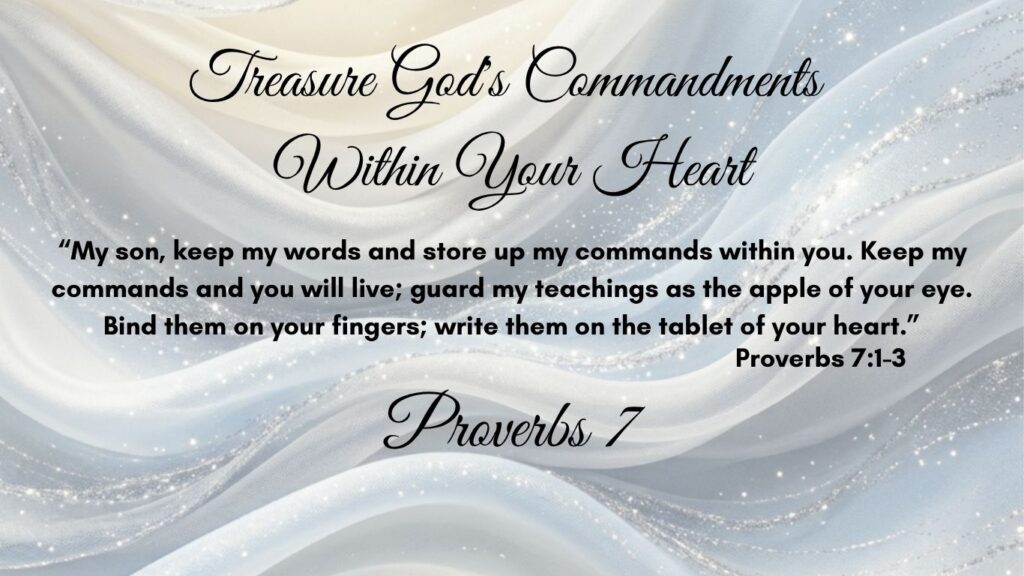
To treasure God’s commandments within your heart is more than remembering a list of rules. Proverbs 7:1–3 speaks of treasuring, guarding, binding, and writing them on the heart. Proverbs 7:1–3 speaks of treasuring, guarding, binding, and writing them on the heart. The language is personal because God’s wisdom is meant to shape us from within, long before we face a difficult choice.
Our homes and relationships give us many opportunities to practice this kind of wisdom. We need it when conversations become tense, schedules feel crowded, boundaries must be made clear, or someone needs patient care. We won’t handle every moment perfectly. Still, we can keep returning to God’s words and allow them to guide the way we speak, respond, and love.
Today’s Wisdom of God
Proverbs 7:1–3 (ESV)
“My son, keep my words
and treasure up my commandments with you;
keep my commandments and live;
keep my teaching as the apple of your eye;
bind them on your fingers;
write them on the tablet of your heart.”
Setting the Scene
Proverbs 7 opens with a father addressing his son. Before describing a serious temptation and its consequences, he urges his son to keep wise instruction close. The repeated words—“keep,” “treasure,” “bind,” and “write”—show that a passing acquaintance with wisdom isn’t enough. The son will need to remember and value what he has been taught so that it can guide him when a choice must be made.
The instruction becomes increasingly personal. These commandments are to be treasured, guarded like “the apple of your eye,” bound on the fingers, and written on the heart. Wisdom belongs near our actions and within our deepest commitments. The statement “keep my commandments and live” presents obedience as the path of life in contrast to the destructive path described later in the chapter. It isn’t a promise that wise people will never suffer. It is a clear warning against choices that lead us away from what is right and good.
Reflection
The central truth is plain: God’s commandments are meant to be kept close enough to direct us. We aren’t told merely to admire wisdom, agree with it, or reach for it after trouble has already begun. We are told to treasure it. We usually protect what we treasure. We make room for it, return to it, and notice when it’s missing. In the same way, God’s instruction deserves more than occasional attention. To keep his teaching “as the apple of your eye” is to treat it as precious and worthy of careful protection. To bind it on our fingers suggests that wisdom should remain near what we do. To write it on the heart means that obedience cannot be only external. God’s words are to shape our loyalties, desires, and decisions. This isn’t about using Scripture to appear respectable. It is about knowing God’s wisdom well enough that it directs even the choices no one else sees.
The struggle is that many other voices compete for that close place. We can know a commandment and still react from anger, fear, pride, exhaustion, or impatience. In a hard conversation, the quickest response may feel more satisfying than the gentle one. When we feel overlooked, we may be tempted to punish someone with silence, sharp words, or quiet resentment. When our responsibilities pile up, we may treat the people nearest to us as interruptions rather than neighbors to love. This shows why wisdom must be stored before the pressured moment arrives. Treasuring God’s commandments doesn’t remove every conflict or make every decision simple. It gives us a trustworthy place to return when our emotions are loud and our judgment is strained.
We can practice this passage through small, ordinary habits. We might place a verse where we’ll see it during a regular part of the day, read a short passage before checking our phones, or write down one command we want to remember during a difficult conversation. A household could read a few verses at a meal without turning the time into a lecture. Whatever our home or family looks like, we can all create simple rhythms that keep God’s wisdom close. The goal isn’t a perfectly organized devotional routine. It is readiness. Before answering a tense message, we can pause and remember what God has said. Before discussing a household concern, we can decide not to embarrass, threaten, or manipulate the other person. If children are present, we can model repentance by admitting when our own words were wrong instead of using the Bible only to correct them. God’s commandments belong first on our own hearts. They aren’t tools for controlling somebody else.
Writing God’s teaching on the heart takes time, and we won’t do it without failure. We will forget what we meant to remember. We may recognize too late that our tone was harsh, our motives were mixed, or our choice was unwise. We don’t need to hide or pretend we did well. We can admit what was wrong, return to God’s instruction, and ask for help to obey it. We cannot guarantee how another person will respond, but we can pay careful attention to our own words and actions. And little by little, His wisdom begins to show up in the way we listen, apologize, set boundaries, and care for one another.
Short Prayer
Lord, help us, help ME, treasure your words instead of treating them as an afterthought. Bring your wisdom to mind before we speak, decide, or react. When we fail, help us admit it honestly and humbly receive your correction. Write your teaching more deeply on our hearts, and let it shape the way we care for the people around us. Teach us to be more like Your Son! In His precious name we pray. Amen.
Reflection Question
What word or command from God do we need to keep especially close in our present relationships and responsibilities?
Closing Encouragement
We don’t have to master every lesson at once. We can keep God’s words near today—reading them, remembering them, and asking for help to obey them in the next choice before us.
Helpful Daily Resources
- Read the full chapter on Bible.com ~ Proverbs 7
- Enjoy Bible.com ~ Verse of the Day
- Try Bible.com ~ Bible Recap: Read the Bible in a Year Plan
Continue in Wisdom of God
- God’s Word Is a Lamp and a Light
- God Sees Our Ways: Living Honestly Before the Lord
- Trust in the Lord With All Your Heart