
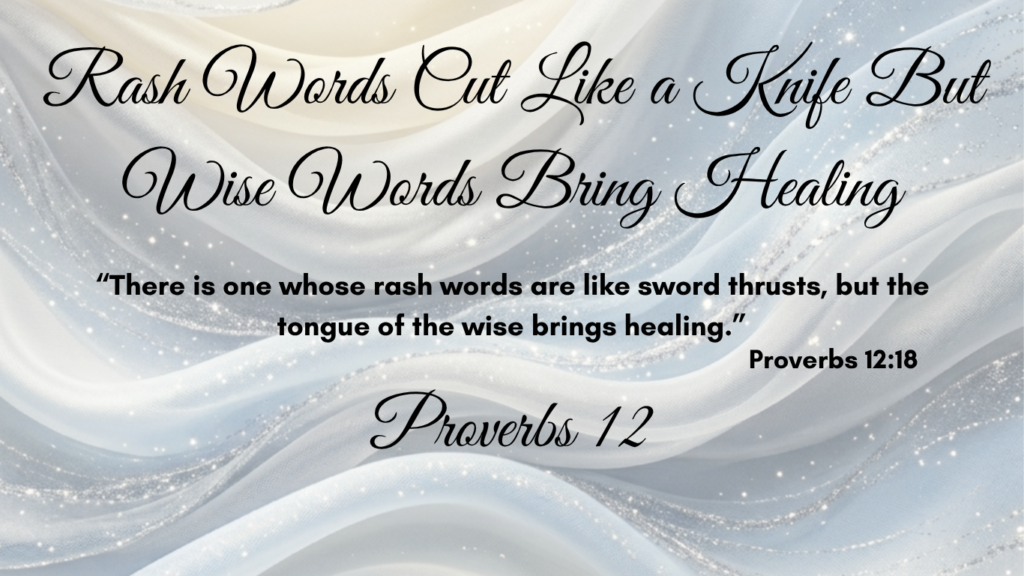
Rash words can leave a mark long after a conversation ends. A sharp reply, a careless joke, or an accusation made in frustration can wound someone deeply. Yet wise words bring healing comfort, clarity, courage, and peace. Proverbs 12:18 places these two possibilities side by side and asks us to consider what our speech is doing.
Most of us know how quickly words can get ahead of wisdom. We may respond before listening, speak from irritation, or say something harsher than we intended. This verse doesn’t call us to hide in shame over every mistake. It helps us see the weight of our words and points us toward a wiser, gentler way of speaking.
Today’s Wisdom of God
Proverbs 12:18 (ESV)
“There is one whose rash words are like sword thrusts,
but the tongue of the wise brings healing.”
Setting the Scene
Proverbs often teaches through contrasts. It places two ways of living side by side so we can recognize their different directions and outcomes. Here, the contrast is between rash words and the tongue of the wise. One kind of speech strikes and wounds. The other contributes to healing. The verse is brief, but its picture is hard to miss: words are not weightless.
Rash words are compared to sword thrusts because they can be sudden, forceful, and painful. Wisdom, however, doesn’t use speech as a weapon. The healing described here shouldn’t be treated as a guarantee that the right words will immediately repair every relationship or remove every hurt. Rather, the proverb shows the direction and character of wise speech. It seeks to help rather than harm, to restore rather than tear down.
Reflection
The message of this proverb is plain: the way we speak matters. Rash words are released without the care that wisdom requires. They may come quickly, before we’ve listened or understood. They may be true but delivered with needless cruelty. By contrast, the wise tongue doesn’t avoid truth; it speaks in a way that helps rather than harms. Healing words may comfort someone who is discouraged, offer a calm correction, admit wrongdoing, or bring clarity to confusion. They don’t have to be eloquent. Wisdom is often heard in simple sentences: “I was wrong.” “Please forgive me.” “I’m listening.” “Let’s slow down.” The difference lies not in polished vocabulary but in whether our speech is being used carelessly or wisely.
Strong feelings can make rash speech seem reasonable in the moment. When we feel misunderstood, we may want to defend ourselves immediately. When we’re frustrated, we may reach for the sentence that will end the discussion or make the other person feel the force of our displeasure. Sometimes the cutting remark forms so quickly that we recognize its harm only after it has been spoken. Proverbs gives us honest language for that harm. We can acknowledge when our words have wounded someone, take responsibility without excuses, and apologize where needed. Regret can lead us toward repair and greater care the next time we speak.
In ordinary life, wise speech often begins before we open our mouths. We can pause long enough to ask whether we understand what was said. We can notice when exhaustion, embarrassment, or anger is pushing us toward a response that may wound. That pause may happen in a family conversation, a text message, a work meeting, a church discussion, or an online exchange. We may ask a question instead of making an accusation, lower our voice, remove a sarcastic phrase, or wait until we can respond more carefully. At other times, wisdom will lead us to speak—to encourage someone, offer a needed apology, or address a problem honestly. Wise words aren’t always soft or easy, but they don’t aim to injure.
We won’t practice this wisdom perfectly, but we can keep paying attention to the effect of our words. When we speak rashly, we can admit it and make amends where we’re able. When a conversation becomes tense, we can slow down rather than letting irritation choose our response. Each exchange gives us another opportunity to listen, pause, and use our words for healing rather than harm.
Short Prayer
God, You know that some of my worst moments were not because of something I did, but because of something I said. I’ve let anger or hurt control my words on more than one occasion, and I know from personal experience that once spoken, words can’t be taken back. I’ve been on both ends of a harsh tongue, and neither is who I want to be. Please, please, Lord, curb my tongue when I’m tempted to lash out. Please remind me of the hurt I’ve felt as the one on the receiving end, and help me respond in a way that glorifies You. Thank You for sending Your Son as a loving example of how I want to be. In Your worthy name I pray. Amen.
Reflection Question
Where could we replace a rash response with words that are truthful, wise, and healing?
Closing Encouragement
We don’t need perfect words for every conversation. We can begin with humility, a willingness to listen, and a pause before we reply.
May our words help rather than wound.
Helpful Daily Resources
- Read the full chapter on Bible.com ~ Proverbs 12
- Enjoy Bible.com ~ Verse of the Day
- Try Bible.com ~ Bible Recap: Read the Bible in a Year Plan
Continue in Wisdom of God
- God’s Word Is a Lamp and a Light
- Seek Wisdom Like Hidden Treasure
- God Sees Our Ways: Living Honestly Before the Lord