
Some verses make sense the moment we read them.
Others make us stop and think, Paul, what in the world are you talking about?
For a long time, Galatians 2:19 was one of those verses for me.
“For through the law I died to the law, so that I might live to God.”
Died to the law?
What exactly does that mean?
But when we read Paul’s words in context, something beautiful begins to emerge. Paul isn’t telling us to stop caring about obedience or righteous living.
He’s telling us that keeping the law could never make us right with God.
Our righteousness isn’t found in what we can accomplish for Him.
It is found in Christ.
And then Paul gives us words that completely change how we understand our new life:
“I have been crucified with Christ. It is no longer I who live, but Christ who lives in me.”
Today’s Saving Grace of God
Galatians 2:19–21 (ESV)
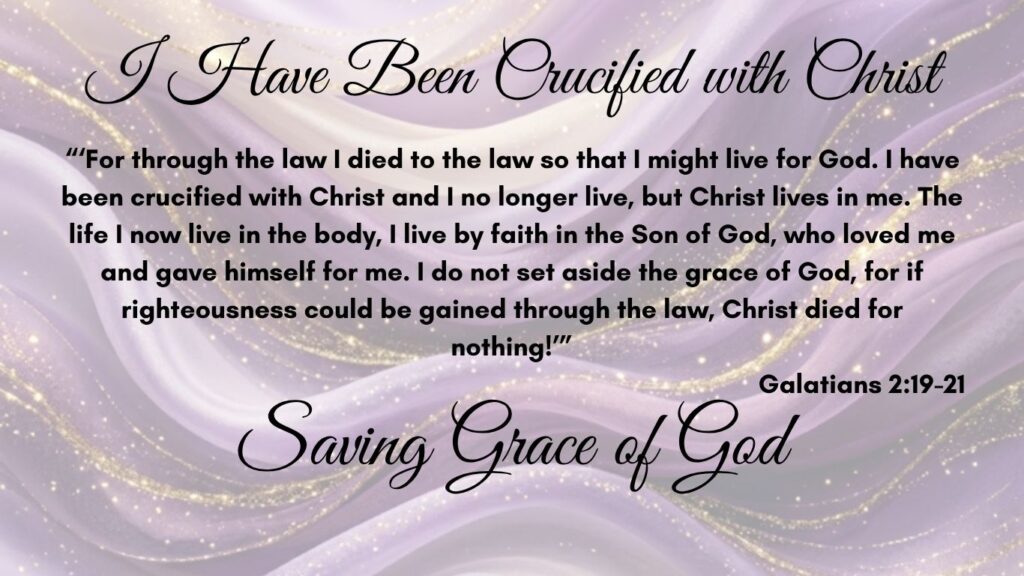
“For through the law I died to the law, so that I might live to God.
I have been crucified with Christ. It is no longer I who live, but Christ who lives in me.
And the life I now live in the flesh I live by faith in the Son of God, who loved me and gave himself for me.
I do not nullify the grace of God, for if righteousness were through the law, then Christ died for no purpose.”
Setting the Scene
To understand these verses, we need to back up a little.
Paul is recounting a confrontation he had with Peter in Antioch. Peter had been eating with Gentile believers, but when certain Jewish Christians arrived, he withdrew from them because he was afraid of criticism from those who emphasized circumcision and Jewish law.
Paul confronted him.
Why?
Because something much bigger than a seating arrangement was at stake.
The gospel itself was at stake.
Just before today’s passage, Paul states the truth plainly: a person is not justified by works of the law but through faith in Jesus Christ.
The Law of Moses had an important place in God’s redemptive story, but keeping the law could never justify sinners before God. If human beings could become righteous through law-keeping, there would have been no need for Christ to die.
But we couldn’t.
So Jesus did.
That’s the context behind Paul’s declaration that he has been crucified with Christ.
His old basis for righteousness is gone. His hope isn’t in his ability to keep the law.
His life is now found in Jesus.
Reflection
For a long time, I misunderstood what Paul meant when he said he had “died to the law.”
I thought the law basically meant righteous living.
But that’s not what Paul is saying.
He’s talking about the Law of Moses and, specifically here, the impossibility of being justified before God by keeping it.
That distinction matters.
Because Paul isn’t telling me that obedience doesn’t matter once I belong to Jesus. He’s telling me that obedience was never capable of saving me in the first place.
And apparently Paul wants to make absolutely sure we understand his point, because he ends with:
“If righteousness were through the law, then Christ died for no purpose.”
Those are strong words.
If I could have made myself righteous before God by following enough rules, doing enough good things, or becoming sufficiently obedient, then why did Jesus need to die?
The answer is simple.
I couldn’t.
Neither could Paul.
Neither can any of us.
And that’s where grace enters again.
Paul says, “I have been crucified with Christ.”
The person I was apart from Christ is no longer where my identity rests. My hope isn’t built on my performance. I don’t wake up every morning needing to prove all over again that I’m good enough for God.
Christ lives in me.
And I love what Paul says next because Christianity doesn’t end at the cross with our sins forgiven and nothing afterward.
There is still a life to live.
“The life I now live…I live by faith in the Son of God.”
That’s where obedience belongs.
Not as the price I pay for salvation.
Not as evidence I can present to convince God I’m worthy.
But as the life I now live because I belong to Jesus.
And when I struggle to live that life faithfully—and I certainly do—Paul gives me somewhere better to look than at myself:
“The Son of God, who loved me and gave himself for me.”
He loved me.
He gave Himself for me.
And now I live by faith in Him.
That’s a much stronger foundation than anything I could ever build for myself.
Short Prayer
Lord Jesus, thank You for loving me and giving Yourself for me. Thank You that my salvation does not depend on my ability to keep every rule or somehow make myself righteous before You. When I start looking at my own performance—whether I’m proud of what I’ve done right or discouraged by everything I’ve done wrong—turn my eyes back to You.
Help me remember that my life belongs to You. Let the life I now live be lived by faith in You, with my eyes on You instead of all the chaos around me. Teach me to surrender my will, trust Your strength, and let my life reflect Your love and grace. In Christ’s name, I pray. Amen.
Reflection Question
Are you depending on your own performance to feel right with God? What would it mean today to rest instead in Christ, who loved you and gave Himself for you?
Closing Encouragement
You were never going to become righteous enough to make the cross unnecessary.
Neither was I.
That’s why Jesus came.
So we don’t have to build our hope on how well we performed yesterday or how well we think we’ll perform tomorrow.
Paul gives us somewhere much safer to place it:
“The Son of God, who loved me and gave himself for me.”
Our old hope in ourselves can die there.
And by faith in Jesus,
we can truly live.
Helpful Daily Resources
- Read the full chapter on Bible.com ~ Galatians 2
- Enjoy Bible.com ~ Verse of the Day
- Try Bible.com ~ Bible Recap: Read the Bible in a Year Plan