
Martha believed in the resurrection.
She knew the teaching. She knew there would be a resurrection on the last day.
But right now, her brother was dead.
Lazarus had been in the tomb for four days. Martha and Mary were grieving. And when Jesus finally arrived, Martha met Him with words that sound like faith and heartbreak tangled together:
“Lord, if you had been here, my brother would not have died.”
I understand that kind of sentence.
Lord, I know who You are…but I don’t understand why You allowed this.
Jesus tells her that Lazarus will rise again, and Martha responds with something she already believes:
“I know that he will rise again in the resurrection on the last day.”
She’s right.
But Jesus doesn’t simply confirm her theology.
He gives her Himself.
“I am the resurrection and the life.”
Martha was looking toward a future resurrection.
The Resurrection was standing right in front of her.
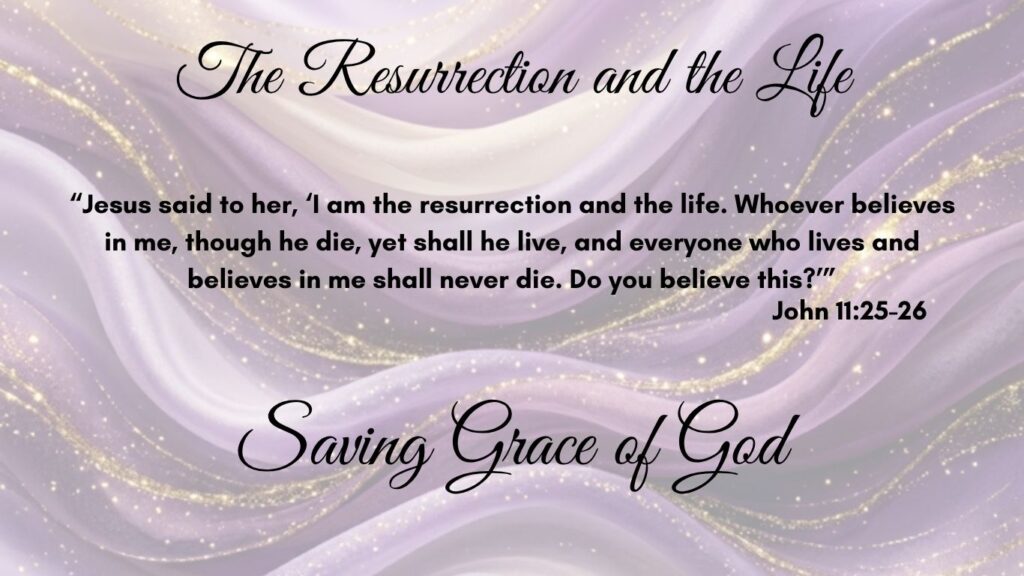
Today’s Saving Grace of God
John 11:25–26 (ESV)
Jesus said to her, “I am the resurrection and the life. Whoever believes in me, though he die, yet shall he live,
and everyone who lives and believes in me shall never die. Do you believe this?”
Setting the Scene
Jesus loved Lazarus and his sisters, Martha and Mary.
So when word reached Him that Lazarus was sick, we might expect Jesus to immediately rush to Bethany.
He didn’t.
Jesus remained where He was for two more days.
By the time He arrived, Lazarus had been dead for four days.
Martha went out to meet Him.
And there, in the middle of her grief, Jesus told her:
“Your brother will rise again.”
Martha knew that.
She believed in the future resurrection of the dead.
But Jesus was about to show her that her hope wasn’t ultimately found in knowing what would happen someday.
Her hope was found in who He is.
Jesus didn’t say:
I can give resurrection.
He said:
“I am the resurrection.”
He didn’t merely say:
I can give life.
“I am…the life.”
And before this chapter ends, Jesus will stand outside Lazarus’s tomb and demonstrate His authority over death itself:
“Lazarus, come out.”
And the dead man will walk out.
But even that miracle points beyond Lazarus.
Lazarus would eventually die again.
Jesus was pointing toward something death could never take away:
Eternal life in Him.
Reflection
There is something about Martha’s conversation with Jesus that gets me.
She knows the right answer.
“I know that he will rise again in the resurrection on the last day.”
She believes God.
She believes in resurrection.
But her heart is still broken because her brother is lying in a tomb.
And Jesus meets her there.
He doesn’t scold her for grieving.
He doesn’t give her a lecture about having stronger faith.
He points her to Himself.
“I am the resurrection and the life.”
That’s important because sometimes I think we can know all the right things about God and still hurt.
We can believe in heaven and still grieve someone desperately.
We can trust God’s goodness and still ask why.
We can know Scripture and still have moments when our hearts don’t understand what God is doing.
Jesus doesn’t demand that Martha choose between grief and faith.
A few verses later, standing near Lazarus’s tomb:
Jesus weeps too.
That may be one of my favorite things about this entire story.
The One who knows He’s about to raise Lazarus from the dead still enters into the sorrow surrounding Him.
Jesus knows death won’t win.
And He still weeps.
So Christian hope doesn’t mean pretending death doesn’t hurt.
It means knowing death doesn’t get the last word.
Because Jesus does.
And then He asks Martha a question that reaches far beyond that road outside Bethany:
“Do you believe this?”
Not:
Do you understand everything I’m doing?
Not:
Can you explain why I allowed Lazarus to die?
Not:
Can you promise you’ll never doubt again?
Do you believe this?
Do you believe that Jesus is who He says He is?
Do you believe He is the resurrection?
Do you believe He is the life?
Do you believe that whoever believes in Him will live even though they die?
That question eventually reaches every one of us.
And Martha’s answer in the very next verse is beautiful:
“Yes, Lord; I believe that you are the Christ, the Son of God, who is coming into the world.”
There it is.
Her hope isn’t ultimately in understanding death.
Her hope is Jesus.
And so is mine.
Short Prayer
Jesus, thank You for being the resurrection and the life.
Thank You that I don’t have to understand everything You allow in order to trust who You are. When grief hurts, when loss doesn’t make sense, and when I find myself asking why You didn’t intervene the way I desperately wanted You to, meet me there just as You met Martha.
Thank You for showing us that grief and faith can exist in the same heart. Thank You for weeping beside those You love and for reminding us that death will not have the final word.
When You ask me, “Do you believe this?” let my heart answer as Martha did:
Yes, Lord. I believe.
You are my Savior, my hope, my resurrection, and my life.
In Your precious name, I pray. Amen.
Reflection Question
When Jesus asks, “Do you believe this?”, what does your heart answer—and how does knowing that He is the resurrection and the life change the way you see death, grief, and eternity?
Closing Encouragement
Martha was waiting for resurrection someday.
Jesus pointed her to Himself.
“I am the resurrection and the life.”
That promise doesn’t mean we won’t grieve.
Jesus wept too.
But because of Him, we do not grieve as people without hope.
For everyone who belongs to Christ, the grave is not the end of the story.
Death doesn’t get the final word.
Jesus does.
And He says:
“Whoever believes in me, though he die, yet shall he live.”
Helpful Daily Resources
- Read the full chapter on Bible.com ~ John 11
- Enjoy Bible.com ~ Verse of the Day
- Try Bible.com ~ Bible Recap: Read the Bible in a Year Plan