
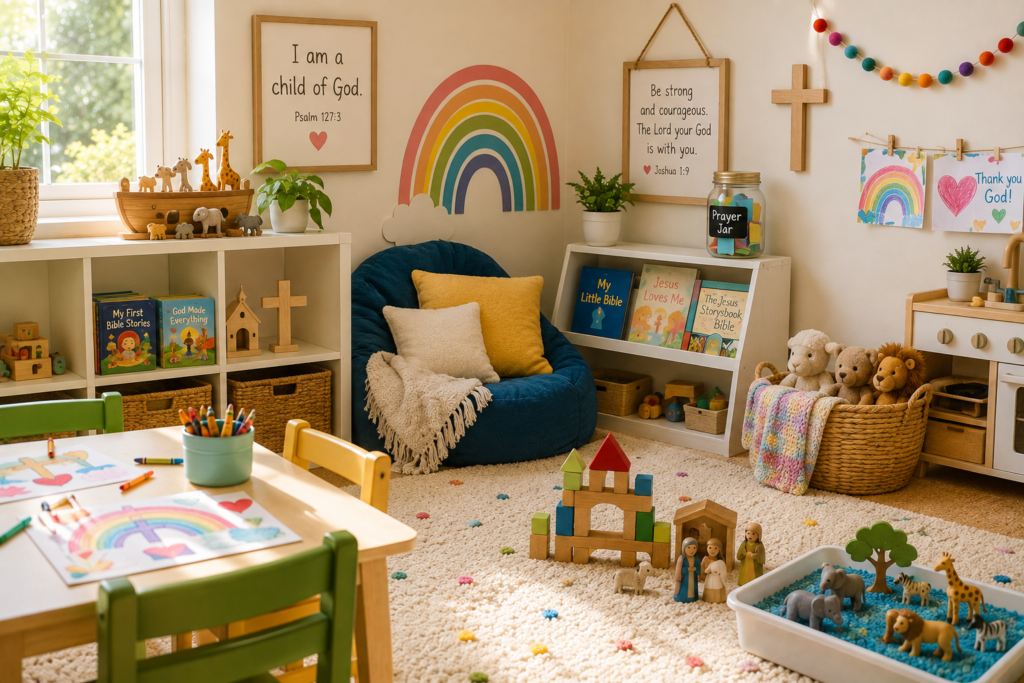
A child’s playroom is a place for building towers, creating masterpieces with crayons, curling up with favorite books, making enormous messes, and letting imagination take over. It can also be a place where children encounter simple reminders of God’s love as naturally as they encounter their favorite toys.
Creating a faith-focused playroom doesn’t mean turning the room into a classroom or filling every wall and toy bin with a Bible lesson. Instead, it’s about thoughtfully weaving faith into a space that still belongs to childhood. A basket of Bible storybooks beside other favorites, a colorful Scripture print on the wall, a Noah’s Ark set mixed in with wooden toys, or a prayer jar filled with names and drawings can quietly make faith part of everyday play.
Whether you have an entire playroom or simply a corner of the family room, small additions can create opportunities for children to ask questions, hear Bible stories, express gratitude, and discover more about the God who made and loves them.
Affiliate disclosure: Some links in this article are affiliate links. If you make a purchase through an affiliate link, I may earn a commission at no additional cost to you. As an Amazon Associate I earn from qualifying purchases.
Keep the Playroom Playful
A faith-focused playroom should still feel like a place where children are excited to play. There’s no need to replace favorite dolls, trucks, building blocks, puzzles, dress-up clothes, or art supplies with exclusively faith-themed toys.
Instead, think about what you can add to the space.
A wooden Noah’s Ark can sit alongside other animal toys. Bible-story figures can join dolls and action figures during imaginative play. A basket of children’s Bibles can share a bookshelf with favorite picture books. Worship music can occasionally become the soundtrack for an afternoon dance party.
These little additions allow faith to become part of ordinary childhood rather than something reserved only for church or family devotional time.
Display Scripture Where Little Eyes Can See It
Scripture artwork can bring meaningful words into a child’s everyday environment, especially when it is colorful, simple, and displayed where children can actually see it.
Instead of choosing long passages, look for short truths children can begin to recognize and remember. Verses and phrases about God’s love, kindness, courage, gratitude, and His presence are wonderful places to begin.
A few framed prints or removable wall decals are plenty. They can even be changed occasionally as children grow or as your family learns new verses together.
You might also display Scripture your children helped create. Let them decorate a verse with crayons, stickers, fingerprints, or watercolor paint and put their masterpiece in a frame. Suddenly, the Scripture on the wall isn’t simply decoration—it carries a memory of something you explored together.
Display Frames for Children’s Artwork
Create a Cozy Faith and Reading Corner
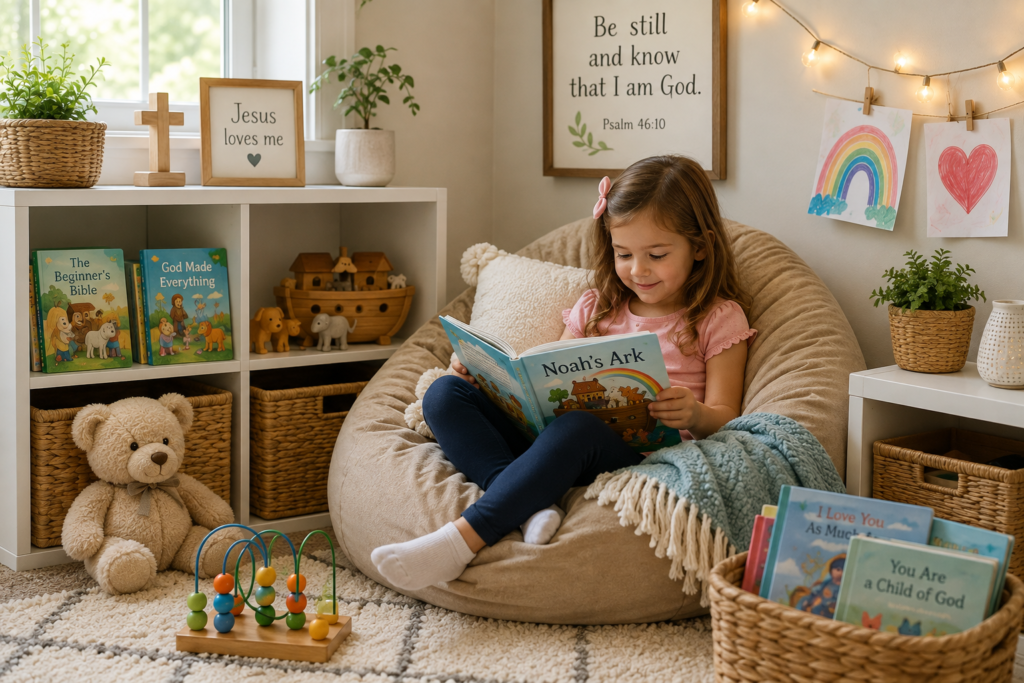
A small reading nook can become one of the sweetest parts of a playroom.
You don’t need much. A beanbag, floor cushions, a soft rug, or a small child-sized chair can create an inviting place to slow down. Keep a basket or low shelf nearby with children’s Bibles, Bible storybooks, books about God’s creation, and other favorite stories.
A colorful prayer or gratitude jar can also live in this area. Children can add drawings, names, or simple notes about people they want to pray for and things they are thankful for.
Parents can occasionally join them in the nook to read a Bible story, talk about something they’re wondering about, or say a short prayer together. Other times, children may simply curl up there with a favorite book.
The goal isn’t to create a place they are required to use for “quiet time.” It’s simply to give them an inviting space where faith, books, conversation, and rest can naturally meet.
Check Out a Comfy Bean Bag Chair
Bring Bible Stories to Life Through Sensory Play
Sensory play offers wonderful opportunities to make familiar Bible stories tangible for young children.
A simple sensory bin can become Noah’s Ark with animal figures and blue sensory materials representing water. A Creation-themed bin might include smooth rocks, leaves, flowers, wooden animals, and other natural treasures. An ocean-themed sensory activity can accompany the story of Jonah.
Even ordinary play dough can become part of the experience. Children can create animals, stars, fish, people, rainbows, or scenes from Bible stories while you talk casually about what they remember.
These activities don’t need to become structured lessons. Children learn through touching, experimenting, pretending, and repeating. Sometimes the best thing a parent can do is introduce an idea and then let the child’s imagination take over.
Make Room for Faith-Filled Creativity
An art area belongs in almost any playroom, and it provides another easy way to encourage children to explore their faith creatively.
Keep washable markers, crayons, construction paper, stickers, glue, and other age-appropriate supplies somewhere children can easily use them.
From time to time, offer a faith-inspired invitation to create. Children might draw their favorite thing God made, decorate a Scripture card, make a rainbow while talking about God’s promise to Noah, illustrate a favorite Bible story, or create a card for someone who needs encouragement.
A gratitude wall or bulletin board can also become an ongoing family project. Children can add pictures or notes representing things they’re thankful for and watch the collection grow.
There doesn’t need to be a perfect finished product. The value is in giving children another way to think about, talk about, and respond to what they’re learning.
Choose Toys That Encourage Faith and Imagination
Faith-inspired toys can be wonderful additions when they encourage genuine play rather than simply delivering information.
Wooden Bible-story figures, Noah’s Ark sets, nativity sets, Bible puzzles, matching games, felt storyboards, musical instruments, and age-appropriate Bible games can all give children hands-on ways to explore familiar stories.
Open-ended toys are especially valuable because children decide what happens next. A set of wooden animals might be part of Noah’s Ark one afternoon and an imaginary zoo the next—and that’s perfectly okay.
Nature toys and activities also provide opportunities to talk about God’s creation. Magnifying glasses, gardening kits, animal figures, leaves, rocks, shells, and flowers can encourage children to notice the details of the world around them.
Wonder itself can become an invitation to faith.
Noah’s Ark Puzzle Toy for Toddlers
Use Music to Fill the Room with Joy
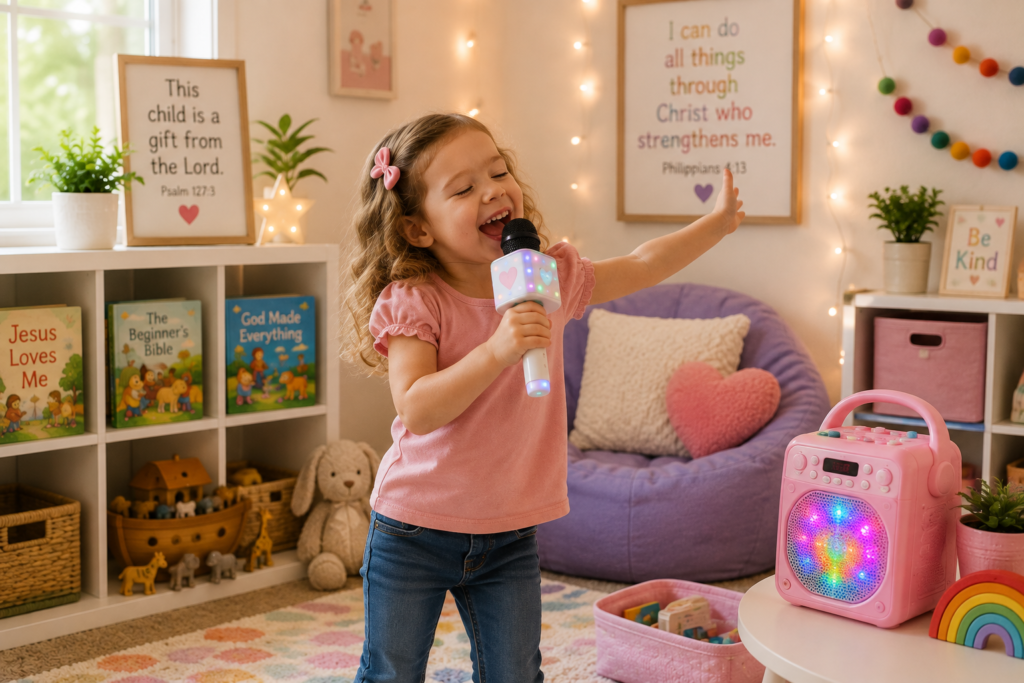
Faith doesn’t always have to happen during quiet moments.
Children’s worship songs, hymns, and Scripture songs can fill a playroom while children build blocks, color pictures, or dance around the room. Musical instruments such as shakers, tambourines, rhythm sticks, or a small keyboard can invite children to make their own joyful noise.
Music can also help children remember truths long before they can read them independently. A simple song about God’s love may stay with a child for years.
There is something wonderfully fitting about a faith-focused playroom occasionally being a little loud.
Check out a Karaoke Microphone
Let Kindness and Service Become Part of Play
Faith can also be practiced through simple acts of kindness.
Keep card-making supplies available so children can create pictures for grandparents, neighbors, teachers, or someone who is sick. They might decorate a box for collecting food-bank donations, choose gently used toys to give away, or help assemble small care packages as a family.
These activities help children begin connecting what they learn about God’s love with how they treat other people.
The conversations don’t need to be complicated. A simple question such as, “How could we show God’s love to someone today?” can give children room to come up with ideas of their own.
Make the Space Fit Your Family
Perhaps most importantly, a faith-focused playroom doesn’t need to look like anyone else’s.
You may have an entire room to work with, or you may have one bookshelf and a basket of toys tucked into the corner of your living room. Both can work beautifully.
You also don’t need to add everything at once. Start with what feels natural for your family. Add a few Bible storybooks. Create a prayer jar together. Put a favorite verse on the wall. Introduce a Bible-themed sensory activity one afternoon.
Over time, you’ll discover which things your children connect with and which ones they don’t.
The goal isn’t to create a picture-perfect Christian playroom. It’s to create a joyful childhood space where reminders of God’s love are simply part of everyday life.
Final Thoughts
Building a faith-focused playroom isn’t about surrounding children with religious decorations or turning playtime into another lesson. It’s about making room for faith within the ordinary things children already love to do.
Books can introduce them to God’s Word. Art can help them express what they’re learning. Sensory play can bring Bible stories to life. Music can fill the room with praise. Nature can inspire wonder. And simple acts of kindness can help children begin to understand what it means to love others.
Most importantly, these little moments create opportunities for conversations—sometimes planned and sometimes completely unexpected.
A playroom filled with laughter, imagination, questions, creativity, and gentle reminders of God’s love can become much more than a room full of toys. It can be one of the everyday places where small seeds of faith are lovingly planted.