

Determining how to choose a Bible translation can feel more complicated than it needs to be. You may see shelves full of familiar abbreviations—KJV, NIV, ESV, CSB, NLT, NASB, NRSVue—and wonder which one is truly “the best.” The honest answer is that the best Bible translation is often the one that helps you read God’s Word carefully, understand what you are reading, and keep coming back with a willing heart.
Readability and accuracy do not have to compete. A Bible that closely follows the wording of the original languages can be deeply useful, but it may take more effort to understand. A Bible written in natural, modern English may be easier to follow, though it may make more interpretive decisions along the way. Understanding these differences can help you choose wisely without feeling pressured to find one perfect edition.
How to Choose a Bible Translation for Your Reading Goals
Before comparing translations, consider what you need this Bible to help you do right now.
Are you looking for a Bible for daily reading, study as a new believer, family devotions, sermon preparation, or detailed personal study? A translation that works beautifully for one purpose may not be the best fit for another.
For example, if you are just beginning to read Scripture regularly, a clear translation in contemporary English may help you stay with the text instead of getting discouraged by unfamiliar vocabulary or long sentences. If you are studying a passage closely, taking notes, or comparing verses during a Bible study, you may appreciate a translation that stays nearer to the structure of the original languages.
There is no shame in owning or using more than one translation. Many Christians read one Bible for daily devotion and consult another when they want to slow down and study. Scripture itself is essential; having several editions is simply a helpful option, not a spiritual requirement.
A few questions can bring clarity:
- Do you want to read longer portions of Scripture comfortably?
- Are you studying a particular book, doctrine, or passage in depth?
- Will you be reading aloud with children, teens, or a group?
- Do you prefer traditional language or everyday English?
- Are you looking for a print Bible, an audio Bible, or a free digital option?
Your season matters. The right choice is not always the most popular translation or the one someone else uses at church.
Understand the Main Translation Approaches
Every English Bible translation draws from ancient Hebrew, Aramaic, and Greek texts. Because languages do not line up word for word, translation always involves careful decisions about grammar, idioms, tone, and meaning.
Most translations fall somewhere along a spectrum between more formal and more functional approaches.
Formal equivalence: closer to original wording
Formal-equivalence translations generally try to preserve the wording, sentence structure, and patterns of the original languages as much as natural English allows. They are often called “word-for-word” translations, though that phrase can be misleading. No translation can simply replace every Hebrew or Greek word with one English word and still communicate clearly.
Translations often placed toward this end of the spectrum include the New American Standard Bible (NASB), English Standard Version (ESV), New King James Version (NKJV), and King James Version (KJV).
These translations can be especially helpful for close study, tracing repeated words, and following the flow of a passage. They may also preserve language that feels more traditional or familiar in some church settings.
The limitation is that some sentences can sound wooden in English, and ancient expressions may need explanation before their meaning becomes clear. Keeping a phrase close to its original form does not automatically make it easier to understand—or more accurate in communicating its intended meaning.
Functional equivalence: clearer thought in modern English
Functional-equivalence translations focus more on communicating the meaning of a phrase or sentence in natural English. Rather than mirroring the original word order, they often express the intended meaning in a way contemporary readers can grasp more easily.
The New International Version (NIV), New Living Translation (NLT), and Christian Standard Bible (CSB) are commonly used translations that emphasize clarity, though each has its own approach and place on the spectrum.
These Bibles can be especially helpful for daily reading, newer Bible readers, family reading, and understanding the larger story of a passage. Their wording may also make connections clearer than they would be in a more formal translation.
That does not mean these translations are careless. Responsible translation committees work seriously with the biblical languages and available manuscripts. Still, when translators choose a clear English phrase for an ancient expression, they are making an interpretive decision. That choice can be helpful, but it is also one reason comparing translations can deepen your understanding.
Paraphrases: useful companions, not primary study tools
A paraphrase restates Scripture in fresh, contemporary language, often with greater freedom than a standard translation. Some readers find paraphrases helpful for hearing a familiar passage in a new way or for devotional reflection.
Still, a paraphrase is best used alongside a translation rather than as your only Bible for serious study, teaching, or forming convictions about a difficult passage. It can offer a helpful perspective, but its wording should be checked against a reliable translation when precision matters.
Accuracy Is More Than Being “Word for Word”
It is understandable to want the most accurate Bible possible. Scripture matters. Words matter. But accuracy involves more than matching English words to ancient ones.
Languages communicate meaning through word choice, grammar, context, figures of speech, and cultural assumptions. A highly literal rendering of an idiom may leave a modern reader confused. In some cases, a clearer English expression communicates the original meaning more faithfully than a rigidly literal rendering would.
For that reason, it helps to move away from the idea that one translation is accurate while another is merely readable. Strong Bible translations seek both faithfulness and clarity, even though they balance those goals differently.
Instead of asking only, “Which translation is the most accurate?” try asking:
- Does this translation take the original languages seriously?
- Can I understand what I am reading without constantly losing the meaning?
- Does it help me notice the context of a passage?
- Is it suitable for the kind of reading or study I hope to do?
- Can I compare it with another trustworthy translation when a verse seems unclear?
A Bible you can understand and return to consistently is often more useful than one that remains closed because it feels inaccessible.
Compare Translations Without Becoming Overwhelmed
Comparing translations can be a simple, grounding practice. When a verse seems confusing, read it in two or three trusted translations. Notice where the wording is similar and where it differs.
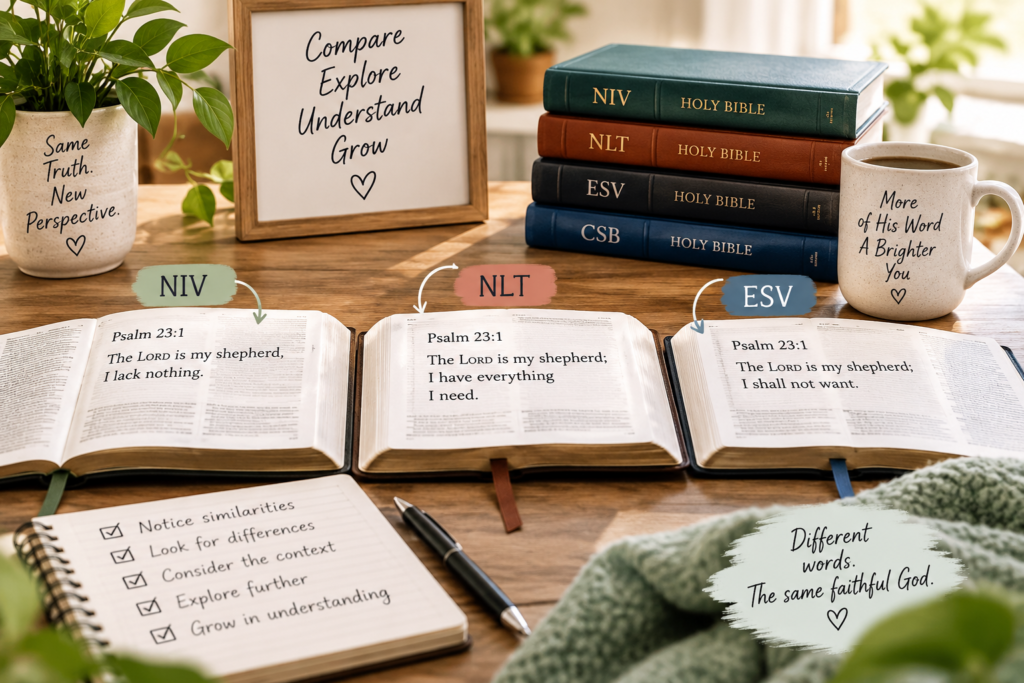
You do not need to become an expert in Hebrew or Greek to benefit from this. A quick comparison can help you see the central meaning more clearly. It may also reveal where a passage contains a difficult word, an ancient idiom, or a translation decision worth studying further.
For a balanced approach, you might read a passage in one clear, everyday translation and then consult a more formal translation. For instance, if you read the NLT or NIV for daily reading, you might compare a difficult passage with the CSB, ESV, NASB, or NKJV. The exact pairing matters less than using translations responsibly and allowing the context to guide your understanding.
Study Bibles can also be useful because they include introductions, maps, cross-references, and notes. But the notes are not Scripture. They reflect the work and theological perspectives of their editors, so read them thoughtfully rather than treating every comment as final.
Pay Attention to Theology, Church Context, and Translation Notes
Bible translation is not only a language question. Christians from different traditions may have preferences shaped by worship, preaching, theology, and long-held familiarity.
For example, some churches regularly use the KJV or NKJV because of their traditional language and textual heritage. Others prefer the ESV, NIV, CSB, NASB, or NLT for preaching and group study. The NRSVue is also used in many academic settings. These associations can provide context, but they should not replace thoughtful discernment.
Translations also make different choices regarding gender language, ancient manuscript variations, and terms with more than one possible English meaning. Most quality Bibles explain many of these choices in footnotes or a preface. Reading the introductory pages may not feel exciting, but it can tell you a great deal about a translation’s goals and methods.
If you belong to a church community, ask which translation is commonly used in sermons and Bible studies. Using the same translation can make it easier to follow along and participate. At the same time, consulting other trustworthy translations can be especially helpful when you are studying a challenging passage.
“Pastors, mature believers, and teachers can be helpful guides, but choosing a translation shouldn’t become a source of fear or pressure. Take time to understand how a translation was produced, read its translation philosophy, and choose one that helps you engage carefully with Scripture.”
Consider Format, Features, and Budget
The translation is the main decision, but format matters too. A beautiful cover or extensive study section does not make a Bible more spiritually valuable. What matters is whether you can comfortably use it in your daily life.
A large-print Bible may be easier to read for extended periods. A compact Bible may travel well but have smaller text and fewer notes. A journaling Bible can provide space for reflection, while a simple paperback may be the most practical choice if you are on a tight budget.
Free Bible apps and websites make it easy to compare translations, listen to audio Scripture, and search for passages. These can be wonderful tools, particularly if buying multiple print Bibles is not possible. Still, notifications, advertisements, and the pull of other apps can make digital reading feel scattered. A print Bible is not holier, but it may offer a quieter reading experience.
You do not need a costly leather Bible, a large library, or a specialized study edition to begin. A reliable translation in a format you can actually use is enough.
Final Thoughts
Learning how to choose a Bible translation is not about proving that you picked the one correct option. It is about finding a trustworthy way to hear and study God’s Word with attention, humility, and growing understanding.
Choose a translation you can read faithfully, then give yourself permission to compare it with others when needed. Scripture, prayer, wise church community, and patient study belong together—and no Bible edition or study tool can replace them.