

Family traditions can feel difficult when our days don’t line up. One person leaves early, another works evenings, children have different activities, and weekends may carry their own demands. Add shared custody, caregiving, illness, or a season of grief, and the picture of everyone gathering at the same table at the same time can feel more discouraging than helpful.
But simple family traditions do not require a perfect schedule. They can be small, repeatable points of connection that remind us, “We belong to one another.” Rather than building traditions around an exact hour, we can build them around moments that happen naturally in our homes and families.
A predictable rhythm can be comforting, especially for children, but predictability does not have to mean rigidity. The American Academy of Pediatrics encourages families to balance regular routines with flexibility, recognizing that children’s schedules and bedtimes may differ. Family routines can take shape in the order that works for a household, not according to someone else’s ideal timetable.
Choose a cue instead of a clock
A tradition built around 6:00 p.m. may work for some families, but it can quickly fall apart when work shifts change or one child has practice. A tradition built around a cue has more room to breathe.

We might connect our tradition to the first person arriving home, the last child getting ready for bed, Saturday morning, a car ride, or the beginning of a new week. The cue stays recognizable even when the time changes.
For example, we might try:
- The first person home chooses a worship song or family playlist.
- Whoever is packing lunches adds an encouraging note to a lunchbox or backpack.
- Before each child’s bedtime, we read one short story, say a prayer, or share one good thing from the day.
- On Sunday, each family member sends a voice note with a prayer request or a moment of gratitude.
- When everyone is in the car together, even briefly, we ask one simple question: “What is something you’re looking forward to?”
These practices may not look impressive from the outside. That is part of their gift. They are designed to fit real life, not compete with it.
Let shared meals take more than one form
Family dinner receives a lot of attention, but dinner is not the only meal that matters. Many households cannot gather every evening, and that does not mean they are missing their chance to connect.
A shared meal can be breakfast before school, a late-night snack after a shift, takeout in the car before an activity, or pancakes on a slower Saturday. We can also make room for one weekly meal rather than expecting a daily one.
Research on family mealtimes suggests that eating together more often is associated with several positive outcomes, but it does not prove that a certain number of dinners will create a healthier or happier family. Shared meals are worth pursuing when they are possible, but they are not a measure of our love or faithfulness.
A simple meal tradition might be Sunday soup night, Friday frozen pizza and a family movie, or a monthly breakfast at a local diner. If money is tight, it may be toast and eggs around the kitchen counter. The food is not the point. The welcome is.
For families who rarely eat all together, we can make a shared question part of the meal, even if people answer at different times:
- What made you laugh today?
- Where did you see kindness this week?
- What felt hard?
- What can we pray about?
- What is one thing we can thank God for?
We do not need everyone to answer perfectly. We are simply leaving the door open for conversation.
Create a short bedtime rhythm that can travel between caregivers
Bedtime traditions can be especially meaningful for young children because they bring a familiar sequence to the close of the day. A routine does not need to be lengthy or elaborate to feel steady. Bath, pajamas, teeth, a book, a prayer, and lights out may be enough.
The National Academies notes that routines around sleep, feeding, and learning can help create order and predictability for young children, while also recognizing that family circumstances affect which routines are realistic. A short bedtime pattern can be shared by a parent, grandparent, babysitter, or another trusted caregiver. It does not have to depend on one person doing everything exactly the same way.
For a child who moves between homes, a small, repeatable ritual can provide a sense of familiarity. Perhaps it is the same goodnight blessing, a favorite book kept in both homes, or a simple prayer thanking God for one part of the day. We can keep it gentle and uncomplicated.
Older children and teens may not want a full bedtime routine, and that is okay. A brief check-in at the bedroom door, a note on the counter, or a standing invitation to talk while folding laundry may become its own kind of tradition.
Make room for traditions that happen apart
Not every family member will be present for every meaningful moment. Some work overnight shifts. Some travel. Some live in another town. Some children move between households. Some loved ones are no longer with us.
Connection can still have a rhythm when we are not all in the same room.

A family group text can become a place for a Monday blessing, a photo from the day, or a simple “thinking of you.” A shared digital album can hold pictures of ordinary life: the dog asleep in a sunny spot, a child’s art project, the first snow, a birthday cake. These are not proven solutions for family stress, but they can be practical ways to say, “You are included in our days.”
We might also try a weekly voice message for relatives who live farther away. Grandparents can record a short prayer or tell a family story. An adult child can send a photo from a meal or walk. A parent working an evening shift can leave a note for the morning.
The goal is not constant contact. It is a dependable thread of care.
Keep faith present without making it heavy
Christian family traditions can be beautifully simple. We do not need to turn every gathering into a lesson or create a long devotional plan for it to be meaningful.
We can light a candle before dinner during Advent, choose one person to offer a short prayer before a weekend meal, or keep a basket where family members place written prayer requests. During Lent, we might choose one small act of service to do together. At Easter, we can read the resurrection story in age-appropriate portions, share a special breakfast, or invite someone who would otherwise be alone.
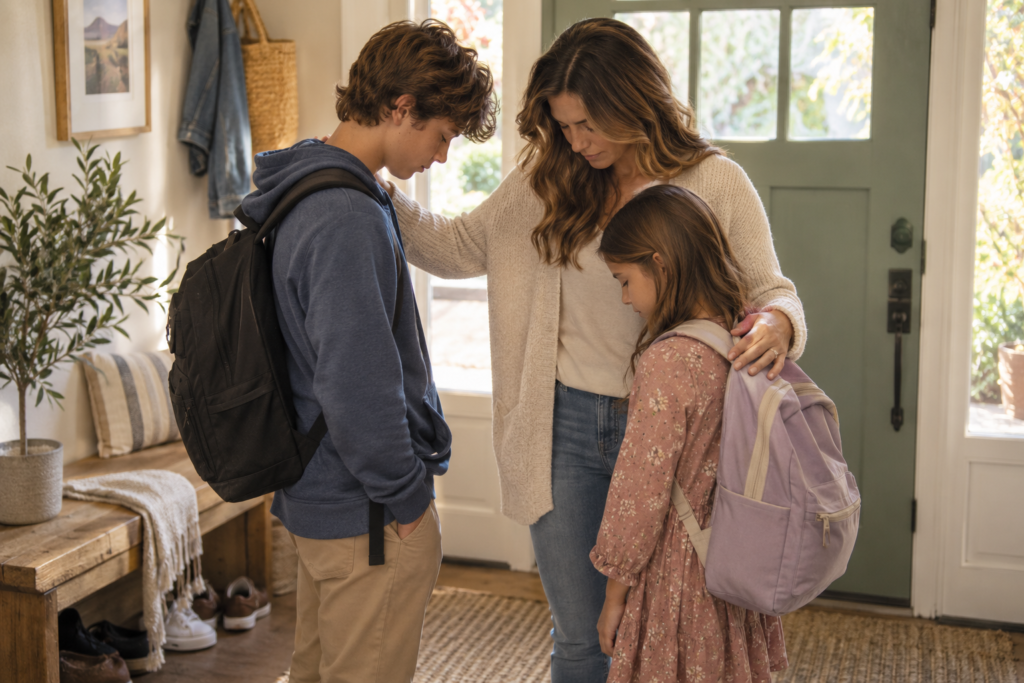
At the start of a new school year, we might pray over backpacks. At the beginning of summer, we might take a walk and thank God for the beauty around us. When a loved one has died, we might cook their favorite recipe, tell stories about them, or place flowers somewhere meaningful.
None of these practices are requirements. They are invitations. Different Christian traditions mark seasons in different ways, and families can honor that variety with humility.
Sometimes the most faithful thing we can do is pray a two-sentence prayer when everyone is tired: “God, thank You for carrying us through this day. Give us rest and help us love one another tomorrow.” That is enough.
Plan Simple Family Traditions for the Life We Actually Have
Traditions tend to last when they match our current capacity. A beautiful idea that requires extra shopping, decorating, driving, and coordinating may become another task we dread. Before starting something new, it helps to ask a few honest questions.
How much time do we truly have? What part of the week already has a natural pause? Who needs this tradition to be easy? What could we do with what we already own?
A low-cost tradition might involve library books, a neighborhood walk, hot chocolate at home, a favorite song, or a monthly game night with whatever snacks are in the pantry. Hospitality can be simple too. Inviting someone for soup, coffee, or a seat at the table does not require a decorated home or a carefully planned menu.
We can also build in a “small version.” If our usual Saturday outing does not happen, perhaps we still share a five-minute porch conversation. If a holiday gathering is too much this year, we may light one candle, make one phone call, or say one prayer of remembrance.
A tradition that can bend is more likely to survive hard seasons.
Give grief and family complexity a place at the table
Not every tradition feels comforting every year. Holidays and anniversaries can bring loss into sharper view. Blended families may be navigating new arrangements. Estrangement, divorce, financial strain, and loneliness can make familiar celebrations feel tender.
We do not have to force cheerfulness or pretend that every tradition still fits. Some years, we may need to pause a practice, simplify it, or make something new. Children can be told in age-appropriate ways that it is okay to miss someone and still enjoy a good moment. Adults need that permission too.
A remembrance tradition may be as quiet as setting out a photo, donating a favorite book, cooking a loved one’s recipe, or speaking their name in prayer. If gathering is painful or unsafe, we can choose boundaries that protect our peace. Family connection is valuable, but it should not require us to ignore harm.
Grace makes room for both joy and sorrow. Often, they sit closer together than we expect.
Final Thoughts
The best simple family traditions are rarely the most elaborate ones. They are the ones that return us to one another, again and again, in ways our real schedules can hold.
Whether our rhythm is a bedtime prayer, a Saturday breakfast, a voice note from work, or a candle lit in memory, we can let it be small enough to sustain and meaningful enough to remember.